Bird-friendly glass
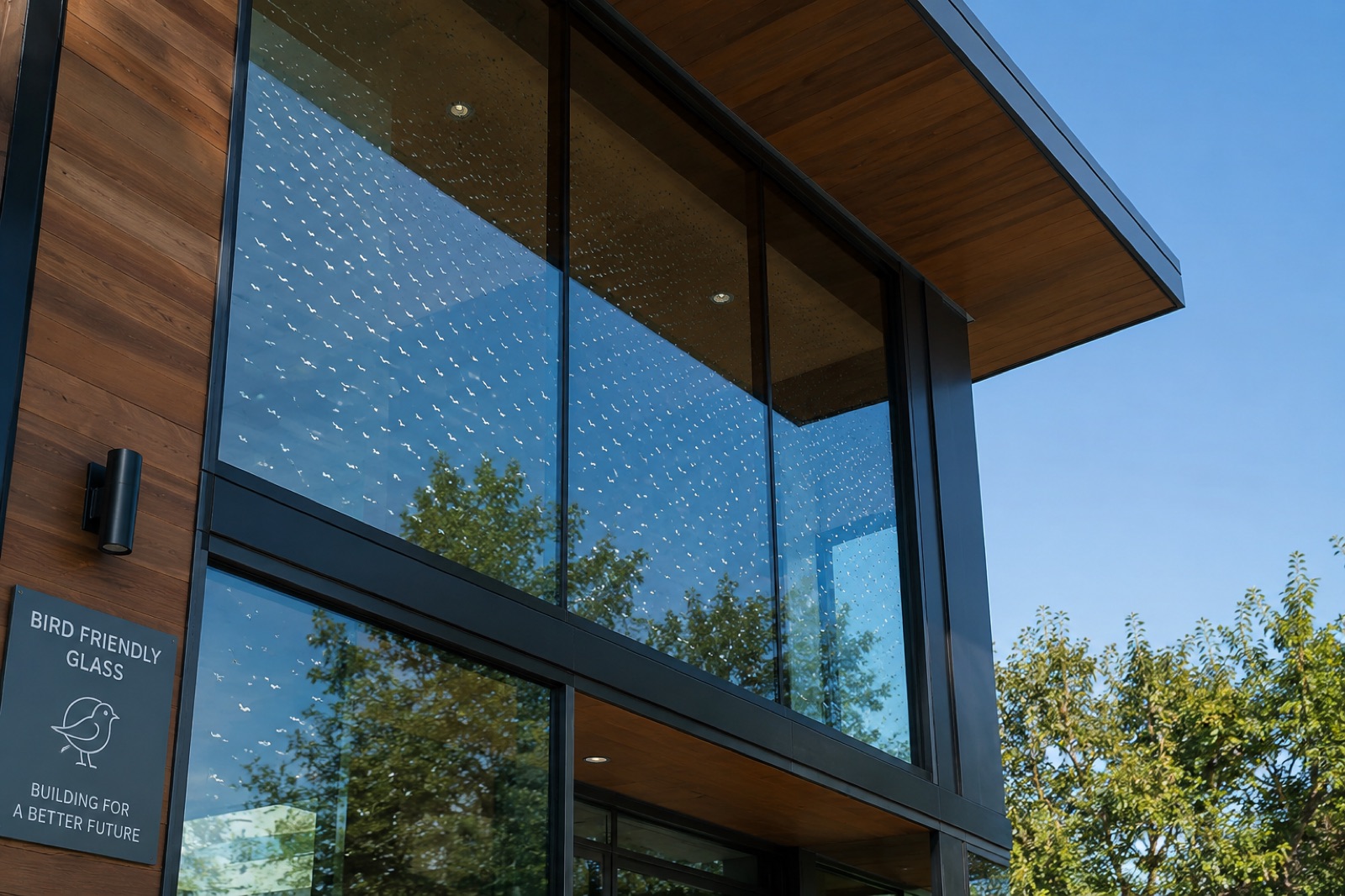
Birds don't see glass as a barrier, they see the sky or vegetation reflected in it, or open space straight through it. Bird-friendly glazing breaks that illusion with a visible pattern, coating, or texture dense enough for birds to register as a solid surface, while staying visually unobtrusive to people.
Why bird-friendly glass exists
The American Bird Conservancy (ABC) estimates that building glass kills somewhere between 365 million and just under 1 billion birds per year in the US alone, making it one of the largest direct human-caused sources of bird mortality. Collisions happen for two reasons: birds either see a reflection of sky, clouds, or vegetation and fly toward it, or they see through two panes of clear glass on opposite sides of a building (a corner, a skywalk, a glazed corridor) and perceive open space where there is none. Both problems are worst on lower floors near vegetation and water, most building-glass strikes happen within the first 3–4 stories, but any large expanse of reflective or transparent glass on a flight path is a risk.
Bird-friendly glass solves this by adding a visual marker that's dense enough across the glass surface that birds perceive it as an object to avoid, while keeping the marker small, light, or subtle enough that human occupants barely notice it.
The rule that governs every pattern: ABC's "2x4" spacing
There's no single mandatory national standard for bird-friendly glass in the US, but there is a dominant voluntary one that nearly every manufacturer, ordinance, and rating system references: the American Bird Conservancy's Bird-Friendly Building Guide, which assigns every glass product a Material Threat Factor (a score out of 100 derived from tunnel testing with live birds, lower is safer). LEED's Pilot Credit 55 (Bird Collision Deterrence) and most city ordinances (New York City's Local Law 15, plus rules in San Francisco, Oakland, Toronto, and others) are built around the same underlying logic.
The practical design rule that comes out of all of this is usually shortened to "2x4":
- Markers no more than 2 inches apart in any continuous direction (vertical or diagonal lines), or no more than 4 inches apart if the pattern repeats in both directions (a grid of dots), this is the general default. Some jurisdictions and high-risk sites (near water, migratory corridors) tighten this to a strict 2"x2" grid.
- Sufficient contrast with the background, markers must be visibly different in tone or reflectivity from the glass itself under normal daylight, not just a subtle texture.
- Coverage of the full pane, not just a border or logo decal in one corner, birds react to the open, unmarked area of glass, not the marked edge.
Techniques used to create the pattern
Six distinct methods are in active commercial use, each with different cost, durability, and aesthetic tradeoffs.
1. Ceramic frit, silkscreen printing
This is the most common and most durable method. A ceramic ink (frit), a suspension of finely ground glass particles, pigment, and a binder, is pushed through a fine mesh screen (typically 30–80 mesh, stretched over the exact pattern as a stencil) onto the glass surface with a squeegee, the same basic process as t-shirt screen printing. The printed glass then goes through the tempering furnace; at tempering temperature (around 1200°F / 650°C) the frit fuses into the glass surface permanently, see our tempering process article for how that furnace cycle works. Because the pattern is vitrified into the glass itself, it can't peel, fade, or wear off, which is why frit is the default choice for permanent architectural bird-friendly glazing.
2. Digital ceramic printing
Instead of a fixed screen, an inkjet printhead deposits the same ceramic frit ink directly onto the glass in a computer-controlled pattern, then it's fired in the furnace the same way as silkscreened frit. Digital printing removes the screen-setup cost and lets every pane carry a unique, non-repeating, or gradient pattern (denser at the bottom, fading toward the top, for example), useful on large curtain-wall jobs where a single repeating dot grid would look monotonous. It costs more per square foot than screen printing at high volumes but is cheaper for short runs or one-off custom designs.
3. Acid-etching
The glass surface is etched (chemically or with a sandblast-style process) to create a translucent, frosted pattern rather than an opaque printed one. Etched bird-friendly products are more subtle, closer to a textured finish than a visible dot grid, and are typically rated with a higher (less safe) Threat Factor than dense ceramic frit unless the etch is deep and well-spaced. Several manufacturers' bird-friendly lines combine etching with frit for extra contrast.
4. UV-reflective coatings
Birds can see well into the ultraviolet spectrum, which humans can't. UV-reflective coatings print a pattern that's essentially invisible to people in normal light but reflects strongly in UV, theoretically deterring birds without any visible marking on the glass at all. This is the most architecturally "invisible" option, which makes it attractive for views and daylighting, but ABC's tunnel testing has generally scored UV-only treatments with notably higher (less effective) Threat Factors than visible ceramic frit patterns, and effectiveness is more dependent on weather, lighting angle, and bird species than visible patterns are. Treat UV coatings as a supplement to a visible-pattern strategy, not a guaranteed substitute, unless the specific product has third-party tunnel-test data to back its claims.
5. Patterned laminated interlayers
For laminated glass, the dot or line pattern can be printed onto the PVB or interlayer film itself rather than onto a glass surface, then laminated between two panes. This protects the pattern from any exterior weathering or cleaning abrasion (it's sealed inside the laminate) and is common where bird-friendly glass also needs to be laminated safety glass (overhead glazing, balustrades).
6. Applied film and surface-mounted markers (retrofit)
For existing buildings where reglazing isn't practical, adhesive dot tape or printed window film is applied to the exterior glass surface after the fact. It's the lowest-cost option and the only one that doesn't require replacing the glass, but it has the shortest service life (films degrade in UV and need periodic reapplication) and is generally treated as a retrofit/mitigation measure rather than a long-term architectural finish.
Which surface of the IGU the pattern goes on, this is the part people get wrong
In a standard double-glazed IGU, surfaces are numbered 1 through 4 starting from the exterior face: Surface 1 is the outermost face of the outer pane, Surface 2 is the inside face of the outer pane (facing the airspace), Surface 3 is the airspace-facing side of the inner pane, and Surface 4 is the innermost face, facing the room.
exterior face
airspace face
airspace
airspace face
interior face
For a bird-friendly pattern to work, it almost always has to be on Surface 1, the exterior face of the outer pane. The reason is straightforward: birds react to what's reflected off, or visible on, the outermost surface of the glass. A pattern fritted onto Surface 2, 3, or 4 sits behind that outer reflective surface; the bird sees the sky and landscape reflecting off Surface 1 same as it would off plain clear glass, because the deterrent pattern is hidden behind it from the bird's point of view. ABC's own product guidance and most manufacturers' tunnel-test ratings are specific to Surface 1 placement, moving an otherwise-identical pattern to Surface 2 typically raises (worsens) its rated Threat Factor substantially.
There are two practical exceptions worth knowing:
- Acid-etched and some UV coatings are sometimes specified on Surface 2 in climates where Surface 1 etching would be more vulnerable to weathering or cleaning abrasion, but this is a deliberate tradeoff accepted with the knowledge that it's less effective, not a default.
- Patterned laminated interlayers are inherently positioned wherever the laminate sits in the makeup (often as the inner pane of an IGU, with the interlayer pattern facing outward through the inner pane's own surfaces), laminated bird-glass products are tunnel-tested as a complete assembly, so check the manufacturer's tested configuration rather than assuming Surface 1 logic applies the same way.
If you're specifying a triple-pane unit or a laminated outer pane, always confirm the manufacturer's tested surface placement directly, a frit pattern that scored well on Surface 1 in testing does not carry that rating if value-engineered onto a different surface during fabrication.
Glass brands offering bird-friendly products
| Brand | Product line | Primary technique |
|---|---|---|
| Viracon | AviProtek® E / AviProtek® IF | Ceramic frit (E) and UV-reflective coating (IF) |
| Walker Glass | Walker Textures® AVIS® | Acid-etched pattern, with frit options |
| Guardian Glass | Bird1st™ | Ceramic frit dot pattern |
| Vitro Architectural Glass | Solarban® bird-friendly options | Ceramic frit, combined with Low-E coatings |
| AGC Glass | Stopray Bird Protect | UV-reflective coating |
| Ornilux (Arnold Glas) | Ornilux Mikado / Protect | UV-reflective coating with spider-web-style visible pattern |
| Goldray Industries | CrystalGuard® | UV-reflective applied film |
| Feather Friendly Technologies | Feather Friendly® dot markers | Applied dot tape (retrofit) |
This list is illustrative, not exhaustive, most major float glass and IGU fabricators now offer a bird-friendly frit option on request, and regional fabricators frequently run custom patterns through their own screen-printing line rather than buying a branded product. Always check the current Threat Factor rating and tested surface configuration for the specific product and pattern density you're specifying, ratings vary meaningfully even within one manufacturer's product line depending on dot size and spacing.
Equipment behind the printing, silkscreen lines and digital ceramic printers
Fabricators producing their own frit patterns (rather than buying a pre-printed branded product) use one of two types of production equipment:
- Flatbed screen-printing lines, a glass-handling table or conveyor with a screen-printing carriage that pulls ceramic ink through a custom mesh screen across each sheet, typically followed directly by loading into the tempering furnace while the frit is still wet (it cures/fuses during the temper cycle). Equipment suppliers serving the architectural glass industry for this kind of line include companies like Glasstech and regional screen-printing equipment makers; many glass fabricators also adapt general industrial screen-printing equipment (e.g., from suppliers like Grünig or Anatol) to glass-specific frit inks and screens.
- Digital ceramic inkjet printers, purpose-built glass printers that jet ceramic frit ink directly onto the sheet without a screen. Dip-Tech (part of Agfa) and Tecglass (their GlassJet line) are the two names most commonly cited as the established players in this space; both sell printers specifically engineered for ceramic frit inks compatible with the tempering furnace cycle, as opposed to general UV-cured inkjet systems used for non-fired decorative glass.
Equipment lineups and model names change; if you're sourcing fabrication equipment rather than finished glass, verify current models and ceramic-ink compatibility directly with the manufacturer rather than relying on this list.
Specification considerations
- Light transmission tradeoff: Denser patterns (tighter spacing, larger dots) score better on bird safety but reduce visible light transmittance (VLT) and can change the perceived color/clarity of the view. There's a real design tension between maximizing daylight and minimizing collision risk, most projects land on the lightest pattern density that still meets the targeted Threat Factor for the site.
- Combining with Low-E: Ceramic frit and digital ceramic printing are both compatible with Low-E coated glass and can be specified on the same IGU, see our Low-E coatings article for how coating surface assignment interacts with frit surface assignment (they're independent decisions, but both need to be coordinated with the fabricator's surface-numbering convention).
- Insulated unit makeup: Bird-friendly frit doesn't change the IGU's basic spacer/airspace assembly, see our insulated glass article for how the rest of the unit goes together.
- Verify, don't assume, the rating: A Threat Factor or "bird-friendly" label on a spec sheet should cite the actual ABC tunnel-test result (or equivalent third-party data) for that exact pattern, density, and surface placement, not a general claim about the product family.